24 July 2026 · Written by: Yeong Weng Sum
M51 Avenue vs Traditional Main-Road Shoplots: Which Is Better?
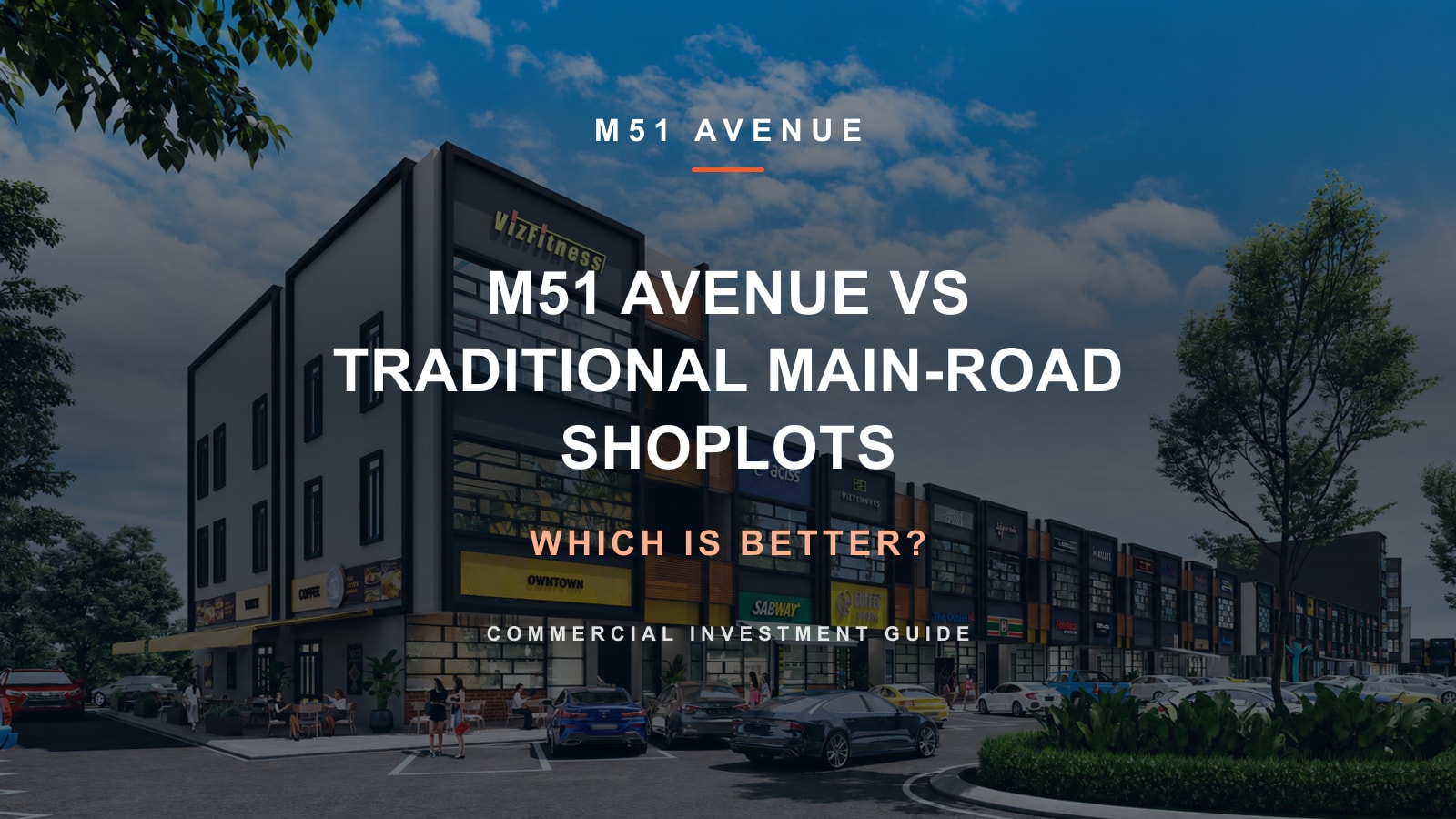
When buyers evaluate a commercial shoplot, one of the first questions is usually:
“Does the unit face the main road?”
Main-road frontage is often associated with stronger visibility, higher traffic and better business exposure. While these advantages are real, a shoplot facing a busy road is not automatically better for every business.
Commercial performance depends on more than the number of vehicles passing in front of the property. Accessibility, parking, traffic circulation, customer convenience and the overall environment can be equally important.
M51 Avenue presents a different commercial concept. Instead of relying solely on direct frontage along a busy external road, the development is planned around a wide internal commercial street that allows customers to enter, park and access the businesses more conveniently.
So, which is better: an M51 Avenue shoplot or a traditional main-road shoplot?
The answer depends on the type of business, the surrounding demand and how customers are expected to use the commercial area.
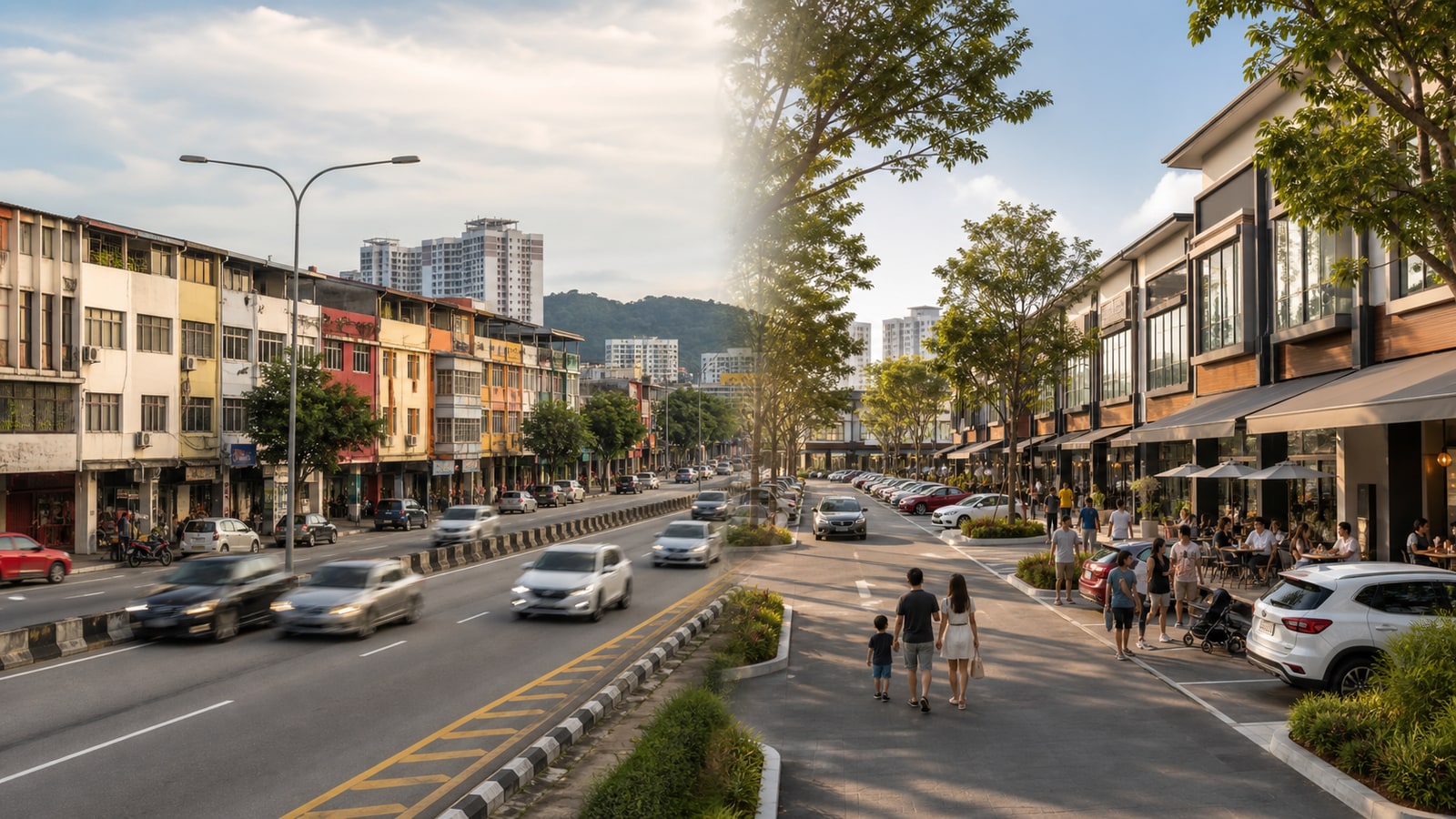
At a Glance
- Traditional main-road shoplots: stronger immediate roadside visibility, especially for automotive, showroom and signage-led businesses.
- M51 Avenue’s internal commercial street: prioritises easier access, organised parking, lower-speed circulation and destination-based visits.
- The better choice: depends on the tenant, customer journey, surrounding demand and future access conditions.
1. Visibility: Main-Road Exposure vs Destination-Based Visibility
Traditional main-road shoplots generally have an immediate advantage in visibility. Thousands of motorists may pass the storefront every day, giving the business continuous exposure.
This can be valuable for businesses that depend heavily on spontaneous purchases or brand awareness, such as:
- Petrol stations
- Fast-food drive-through outlets
- Car showrooms
- Large retail chains
- Billboard-driven businesses
However, high traffic volume does not necessarily mean high customer conversion.
A motorist travelling at 60 or 80 kilometres per hour may see the shop but still be unable to stop safely. The road divider may prevent drivers from turning into the property, or the entrance may be located far away from the storefront.
In comparison, businesses within an internal commercial street may receive less exposure from passing vehicles, but customers who enter the development are already more likely to stop, park and visit.
For businesses such as pharmacies, clinics, cafés, restaurants, salons and service centres, convenient customer access may be more valuable than passive roadside exposure.
M51 Avenue is intended to function as a commercial destination rather than merely a row of shops that motorists pass by.
2. Accessibility: Can Customers Actually Enter Easily?
A highly visible shoplot can still underperform if it is difficult to access.
Some traditional main-road shoplots face common access problems, including:
- Customers needing to make a U-turn
- Road dividers preventing direct entry
- Limited entrance and exit points
- Fast-moving traffic making it difficult to slow down
- Vehicles missing the entrance
- Customers being unable to return after passing the shop
These issues can discourage repeat visits, particularly for businesses where customers expect quick and convenient access.
Accessibility is especially important for pharmacies, clinics, convenience stores and food outlets. Customers visiting these businesses may include elderly people, families, hospital visitors or people who are in a hurry.
M51 Avenue is planned around an internal commercial circulation system. Customers can enter the development, travel along the internal road, locate the business and park nearby.
This type of layout may create a more controlled and user-friendly experience than stopping directly beside a congested main road.
3. Parking: Visibility Is Meaningless if Customers Cannot Stop
Parking is one of the most important factors in commercial property performance, but it is frequently underestimated.
A business may have excellent visibility, but customers may choose a competitor if they cannot find a parking space.
Traditional roadside shoplots may experience:
- Insufficient parking bays
- Illegal roadside parking
- Double parking
- Vehicles blocking shop entrances
- Delivery vehicles obstructing traffic
- Customers parking far away
- Traffic enforcement affecting customer access
For destination-based businesses, customers often remain at the premises for 30 minutes or longer. Restaurants, cafés, clinics, pharmacies, tuition centres, offices and beauty businesses all require practical parking arrangements.
M51 Avenue is designed with a wider internal commercial environment and surrounding parking space. This allows customers to enter the development, park and walk to their intended shop.
A comfortable parking environment may also encourage visitors to stay longer and visit more than one business within the development.
This creates potential for cross-shopping, where a customer may visit a pharmacy, have a meal, purchase groceries or use another service during the same trip.
4. Road Closures and Future Traffic Changes
Main-road access conditions are not always permanent.
As an area develops, local authorities may modify the traffic system to improve safety or reduce congestion. These changes can include:
- Installing road dividers
- Removing direct turning points
- Converting roads into one-way traffic
- Closing informal entrances
- Restricting roadside parking
- Creating new intersections
- Relocating U-turn points
A shoplot that currently enjoys easy direct access may become more difficult to enter after future road changes.
This does not mean that main-road shoplots are poor investments. However, buyers should not assume that today’s access arrangement will remain unchanged indefinitely.
Commercial developments with properly planned internal access may be less dependent on a single roadside entrance or an informal turning point.
For M51 Avenue, the internal commercial road is an important part of the development concept. The project is also associated with a planned wider road network intended to support future access and surrounding development.
Nevertheless, buyers should review the latest approved plans and official information before making an investment decision. Proposed roads and future infrastructure should not be treated as guaranteed until they are formally completed.
5. Traffic Congestion: High Traffic Can Help or Hurt
High vehicle traffic is often presented as a commercial advantage. In reality, traffic can be beneficial only when customers can enter, stop and leave conveniently.
Heavy traffic may create several problems:
- Customers avoiding the area during peak hours
- Difficulty turning into the shoplot
- Long delays when exiting
- Delivery and loading difficulties
- Noise and air pollution
- Reduced pedestrian comfort
- Safety concerns for families and elderly visitors
A busy road may provide exposure, but it can also create a stressful customer experience.
An internal commercial street can provide a more controlled environment. Vehicles are generally moving at lower speeds, customers have more time to identify the businesses and pedestrians can move around more comfortably.
This can be particularly useful for cafés, restaurants and lifestyle-oriented businesses that want customers to spend time in the area rather than make a quick roadside stop.
6. The Value of an Internal Commercial Street
An internal commercial street should not be viewed simply as a row of shops hidden behind the main road.
When properly planned, it can function as a commercial ecosystem.
Customers enter the area with the intention to park, walk, eat, shop or use services. Businesses can benefit from shared foot traffic and complementary tenant categories.
For example, a visitor coming to a pharmacy may also purchase food or drinks. A family visiting a restaurant may notice a convenience store, salon or service centre nearby.
A strong internal commercial street may offer:
- Safer and slower-moving traffic
- Better pedestrian movement
- Easier parking
- More comfortable customer circulation
- Longer customer dwell time
- Opportunities for outdoor events
- Cross-shopping between tenants
- A stronger sense of place
M51 Avenue has been positioned as more than a conventional roadside shoplot development. Its potential value comes from combining local weekday demand with weekend and tourist activity.
The surrounding demand may include residents, Hospital Port Dickson visitors and staff, the nearby army camp, surrounding institutions, hotel guests and travellers visiting Teluk Kemang.
If the development achieves a suitable tenant mix, the internal street could become a recognised destination rather than depending entirely on passing vehicles.
7. Which Businesses Benefit More from Main-Road Frontage?
Traditional main-road shoplots may remain preferable for businesses that require maximum immediate exposure.
These may include:
- Car dealerships
- Tyre and automotive workshops
- Large furniture showrooms
- Building material suppliers
- Drive-through businesses
- Businesses depending heavily on roadside signage
These businesses often serve customers who specifically search for the outlet or need large display frontage and direct vehicle access.
8. Which Businesses May Prefer M51 Avenue’s Internal Environment?
An internal commercial street may be more suitable for businesses that depend on convenient parking, repeated visits and a comfortable customer experience.
Potential examples include:
- Pharmacy
- Medical clinic
- Dental clinic
- Diagnostic centre
- Café
- Restaurant
- Convenience store
- Bakery
- Salon
- Wellness centre
- Tuition centre
- Professional office
- Family-oriented services
For these businesses, the ability to enter easily, find parking and remain in the area may be more valuable than being seen briefly by fast-moving traffic.
9. Main-Road Visibility Is Only One Part of Commercial Value
Commercial property buyers should avoid judging a shoplot based only on whether it directly faces the main road.
A more complete evaluation should consider:
- Who are the customers?
- Where are they coming from?
- Can they enter the development easily?
- Is parking available?
- Is the shop visible after customers enter?
- Is it easy to leave the area?
- Are there complementary tenants nearby?
- Will customers visit on weekdays, weekends or both?
- Could future road changes affect access?
- Does the area feel like a destination?
A shoplot with moderate external visibility but strong accessibility, parking and surrounding demand may outperform a highly visible shoplot that is difficult to enter.
Conclusion: Which Is Better?
There is no universal answer.
A traditional main-road shoplot may be better for businesses that require maximum roadside exposure, large signage and direct visibility from passing traffic.
M51 Avenue may be more suitable for businesses that prioritise customer convenience, parking, internal circulation and destination-based demand.
Its investment potential does not depend solely on being visible from a major road. Instead, it depends on whether the development can attract the right tenant mix and become a convenient commercial destination for nearby residents, hospital users, workers and visitors.
For investors, the key question should not only be:
“How many vehicles pass in front of the shop?”
A better question is:
“How easily can customers enter, park, spend time and return?”
That is where a properly planned internal commercial street may offer a meaningful advantage over some traditional main-road shoplots.
Explore M51 Avenue
Interested in what you read? Take the next step.
Prepared by Yeong Weng Sum
Disclaimer: The information provided in this article is based on publicly available sources, market observations, and the author's own research and opinions at the time of writing. It is intended for general informational purposes only and should not be considered legal, financial, investment, or professional advice. Readers are encouraged to conduct their own due diligence and consult qualified professionals before making any property or investment decisions. The author and website shall not be held liable for any losses or decisions made based on this content.