1 July 2026 · Written by: Sum Yeong
M51 Avenue- Malaysia Vision Valley 2.0 Parcel D: Why Port Dickson Coastal Corridor Matters for Future Commercial Growth
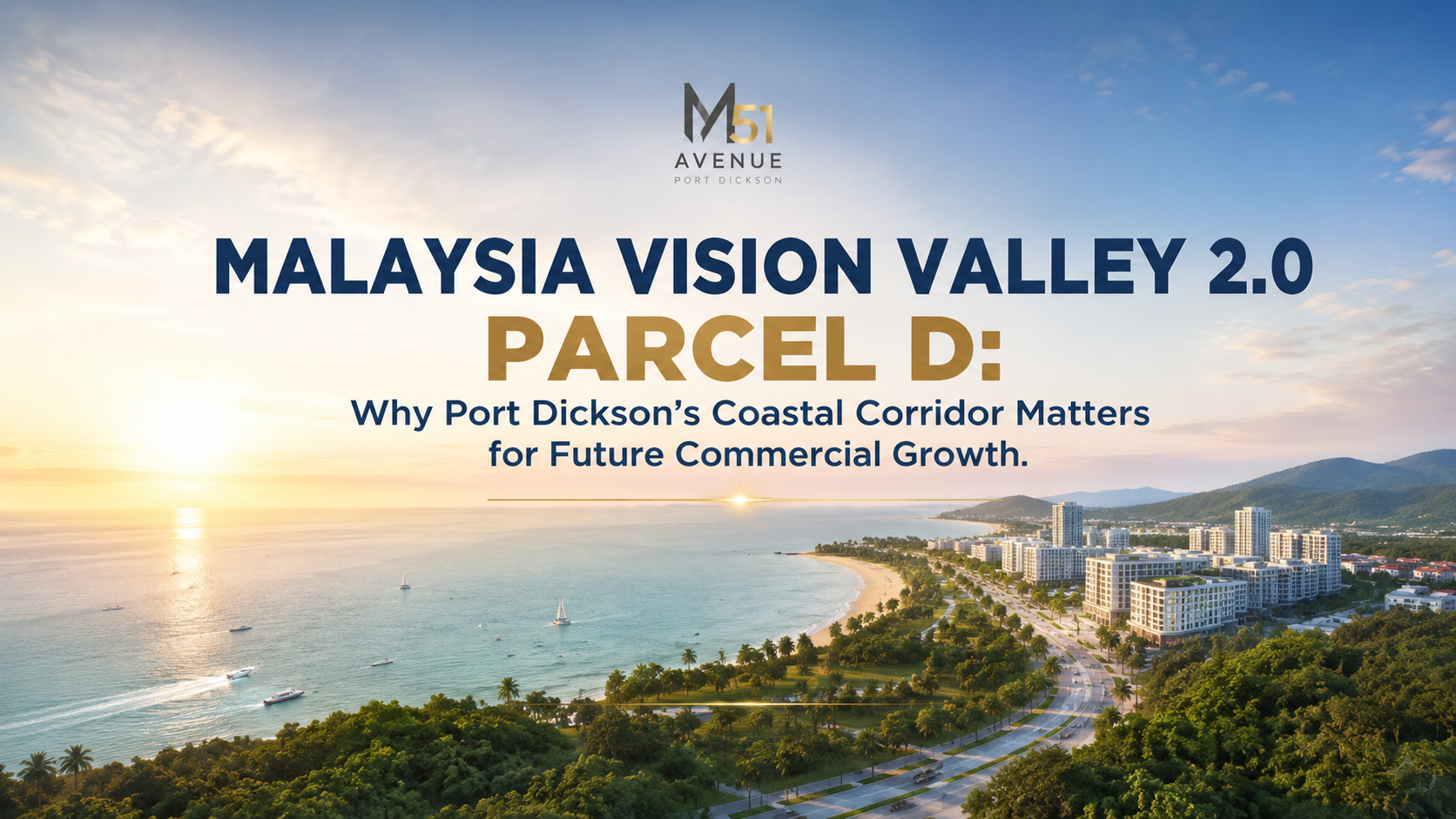
Port Dickson has long been known as one of Negeri Sembilan’s most recognizable tourism destinations. For many Malaysians, it is a familiar weekend beach location. But beyond tourism, Port Dickson is also part of a much larger long-term economic plan: Malaysia Vision Valley 2.0, commonly known as MVV 2.0.
Within this master plan, Parcel D has been identified as the Integrated Maritime Hub & Waterfront Corridor. This gives Port Dickson a more strategic role, not only as a beach destination, but also as a future coastal economic corridor supported by maritime activity, tourism, waterfront development and surrounding commercial demand.
What is Malaysia Vision Valley 2.0?
Malaysia Vision Valley 2.0 is a long-term development blueprint for Negeri Sembilan, covering key areas within Seremban and Port Dickson. The vision is to create a competitive, inclusive and sustainable growth region that can attract investment, generate employment and support future business opportunities.
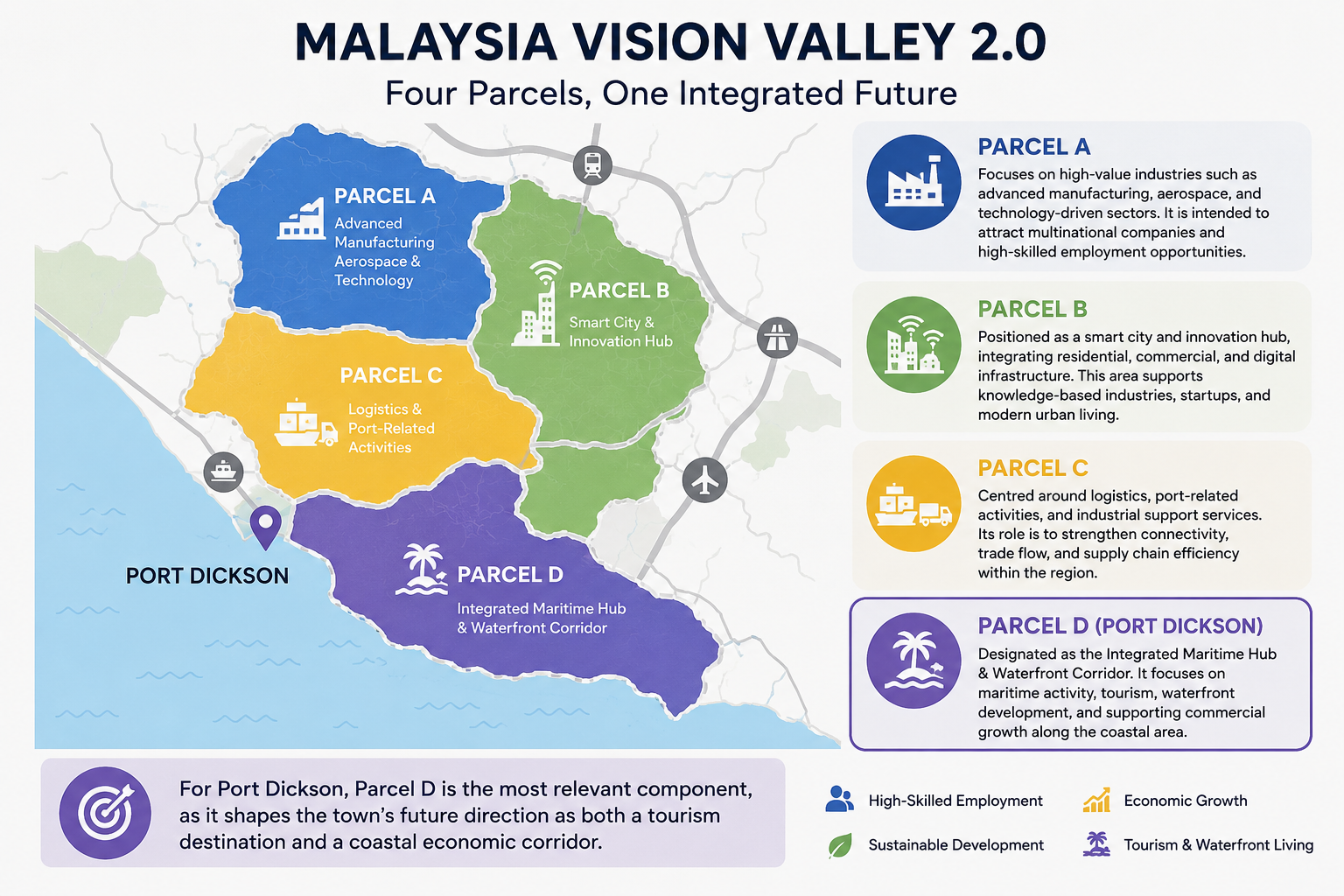
Instead of relying on one single industry, MVV 2.0 is divided into several specialised parcels, each with a different economic focus. These parcels are designed to complement one another and create a balanced economic ecosystem across the region.
Parcel A focuses on high-value industries such as advanced manufacturing, aerospace, and technology-driven sectors. It is intended to attract multinational companies and high-skilled employment opportunities.
Parcel B is positioned as a smart city and innovation hub, integrating residential, commercial, and digital infrastructure. This area supports knowledge-based industries, startups, and modern urban living.
Parcel C is centred around logistics, port-related activities, and industrial support services. Its role is to strengthen connectivity, trade flow, and supply chain efficiency within the region.
Parcel D, which includes Port Dickson, is designated as the Integrated Maritime Hub & Waterfront Corridor. It focuses on maritime activity, tourism, waterfront development, and supporting commercial growth along the coastal area.
For Port Dickson, Parcel D is the most relevant component, as it shapes the town’s future direction as both a tourism destination and a coastal economic corridor.
What is Parcel D?
Parcel D is known as the Integrated Maritime Hub & Waterfront Corridor.
In simple terms, this means the Port Dickson coastal area is expected to play a stronger role in the state’s future maritime, tourism and waterfront economy. This is important because coastal towns with proper infrastructure planning can create stronger demand for supporting businesses such as food and beverage, retail, services, accommodation, healthcare-related services and convenience-based commercial activity.
For investors and business owners, Parcel D is not just about one project. It represents a wider direction for Port Dickson’s future positioning.
Why Parcel D is important for Port Dickson
Port Dickson already has several existing demand drivers. It has beaches, hotels, resorts, residential areas, army-related population, local communities, hospital traffic and weekend visitors. These are real-world demand sources that already exist today.
With Parcel D, the long-term direction becomes clearer. Port Dickson is not only being treated as an old beach town. It is being positioned as part of a larger economic corridor under MVV 2.0.
This matters because commercial property demand is usually strongest when several demand sources overlap in one location. A shoplot area that depends only on tourists may be weak during weekdays. A shoplot area that depends only on local residents may have limited weekend upside. But when residents, hospital users, tourists, hotel guests, beach visitors and future development activity meet in one area, the commercial base becomes more resilient.
How this supports commercial property demand
Commercial property is driven by footfall, accessibility, visibility and spending power. In Port Dickson, the key question is not only whether people visit the area, but whether there are enough properly located commercial units to serve them.
As Port Dickson continues to grow under the wider MVV 2.0 direction, well-positioned commercial areas may benefit from several types of demand:
- Local residents need daily services, food, clinics, convenience stores and retail options.
- Tourists and beach visitors create weekend demand for cafes, restaurants, mini markets, leisure services and lifestyle businesses.
-Hospital-related traffic can support pharmacies, clinics, food outlets, convenience stores and service businesses.
-Hotels, resorts and nearby condominiums bring additional short-stay and semi-residential population into the area.
-Future coastal and maritime-related planning may further strengthen Port Dickson’s identity as a more active waterfront economy.
This is why location selection remains very important. Not every shoplot in Port Dickson will perform the same. Areas with stronger surrounding population, accessibility, visibility and future connectivity will generally have better long-term commercial potential.
Why M51 Avenue is relevant to this growth story
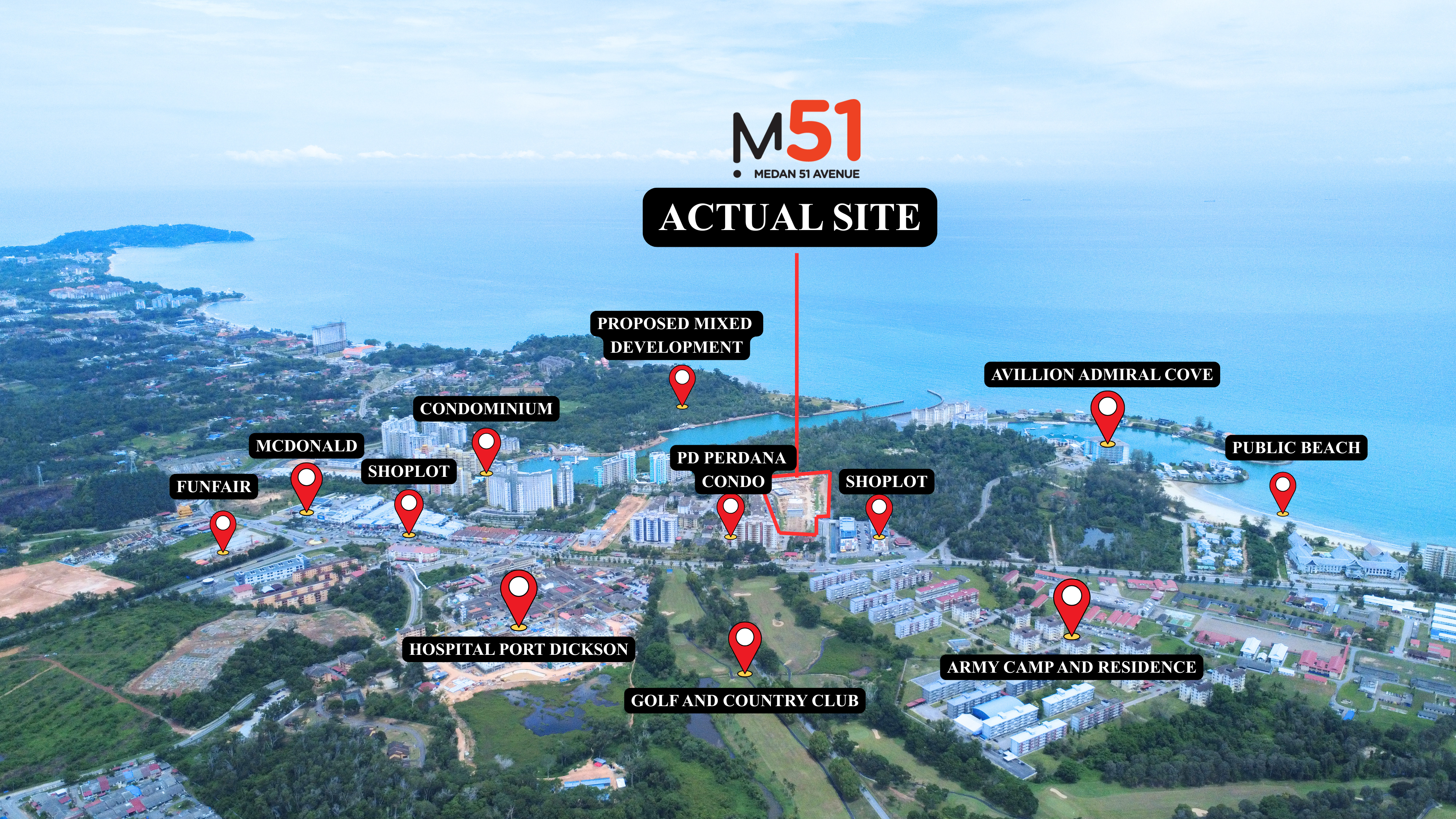
M51 Avenue is located within the Port Dickson growth environment, where local demand and tourism demand meet. The project is positioned near important surrounding demand drivers such as Port Dickson Hospital, nearby residential and condominium catchments, existing commercial activity and access toward beach and tourism areas.
For business owners, this type of location can be suitable for practical daily-demand businesses such as F&B, pharmacy, clinic, convenience retail, service trades, lifestyle concepts and tourism-supporting businesses.
For investors, the key point is that M51 Avenue is not relying on only one customer group. The surrounding catchment includes residents, hospital visitors, weekend tourists, beachgoers, hotel guests and nearby condominium population. This wider demand mix may provide stronger commercial sustainability compared with locations that depend only on seasonal tourism.
A long-term view, not a short-term hype
It is important to view Malaysia Vision Valley 2.0 and Parcel D as a long-term development direction, not an overnight transformation. Large-scale economic corridors take time to materialise. Infrastructure, private investment, tourism growth and commercial maturity usually happen in phases.
However, for commercial property investors, early positioning in a recognised growth corridor can be meaningful if the location already has existing demand today.
This is where Port Dickson becomes interesting. It already has tourism, local population, hospital traffic and surrounding residential catchment. MVV 2.0 Parcel D adds a stronger long-term planning narrative on top of these existing fundamentals.
Conclusion
Malaysia Vision Valley 2.0 Parcel D strengthens the future story of Port Dickson as more than just a weekend beach destination. As an Integrated Maritime Hub & Waterfront Corridor, Parcel D highlights the state’s intention to develop Port Dickson’s coastal economy in a more structured and strategic way.
For commercial property, this creates a more compelling long-term backdrop. The strongest opportunities are likely to be in locations that already have today’s demand while also sitting within the path of future growth.
M51 Avenue fits into this wider Port Dickson growth story by offering commercial space in an area supported by residents, hospital traffic, tourism movement, nearby condos and future connectivity.
For investors and business owners looking at Port Dickson, the question is no longer only “Is this a tourist town?”
The better question is:
Which location can capture both today’s demand and tomorrow’s growth?
Explore M51 Avenue
Interested in what you read? Take the next step.
Prepared by Sum Yeong
Disclaimer: The information provided in this article is based on publicly available sources, market observations, and the author's own research and opinions at the time of writing. It is intended for general informational purposes only and should not be considered legal, financial, investment, or professional advice. Readers are encouraged to conduct their own due diligence and consult qualified professionals before making any property or investment decisions. The author and website shall not be held liable for any losses or decisions made based on this content.